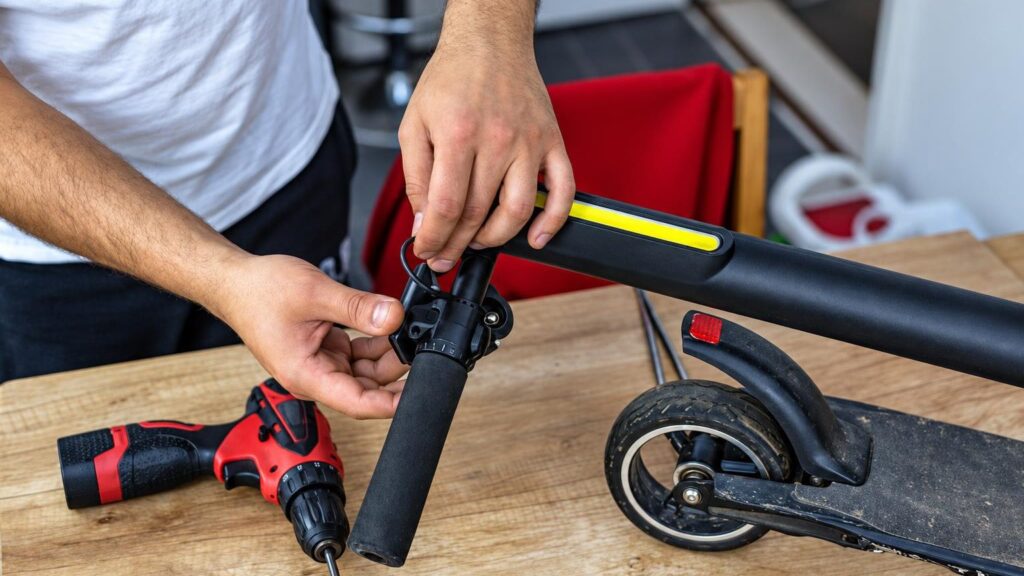
Below are the symptoms in the words customers most often use to describe them at the counter. The exact cause is determined by diagnostics, and only the most common ones are listed here.
01
The electric scooter won’t turn on
WhyThe most common culprits are a discharged or damaged battery, contacts oxidized by moisture, or a faulty power button or controller. After a fall, an internal wire sometimes comes loose.
Check it yourselfConnect the original charger and see whether the charging indicator lights up. Check that the charger plug is properly inserted into the scooter’s socket. Do not disassemble the scooter.
What we doWe measure the voltage, check the controller, button and wiring, and if the battery is the culprit, we offer replacement options.
02
The scooter battery drains quickly
WhyCells lose capacity as they age: after a few hundred charge cycles, the range can drop considerably. Winter also contributes, as cold temporarily reduces capacity, as do damaged or unbalanced cells.
Check it yourselfCompare the range on a warm day with the earlier one. Check the tire pressure – underinflated tires use more energy.
What we doWe assess the condition of the battery and discuss whether a repair is enough or the battery needs to be replaced. For prices, read the article about the scooter battery replacement cost.
03
The scooter won’t charge
WhyThe charger may be faulty, the charging socket may be loose or burnt, or the battery protection board (BMS) may have locked after a complete discharge.
Check it yourselfTry another original charger of the same voltage and a different power outlet. Check whether the charger is heating up or there is a smell of melting – in that case, stop using it.
What we doWe check the charger, the socket and the protection electronics. If the socket is worn, we replace it, and if the battery is locked, we assess whether it can be safely revived.
04
The scooter jerks or doesn’t respond to the throttle
WhyThe most common culprits are the throttle (accelerator) sensor, a broken wire near the handlebar, the motor’s Hall sensors or the controller.
Check it yourselfCheck that the throttle doesn’t return sluggishly or get stuck because of dirt. If the jerking occurs only in the rain, leave the scooter to dry at room temperature.
What we doWe check the throttle, its wire, the motor sensors and the controller. If the fault is electronic, we first determine the exact cause.
05
Punctured tire or air leaking out
WhyThe most common culprits are a nail, glass or an old inner tube. Riding with too low pressure makes the tube break more quickly at the valve.
Check it yourselfInflate the tire to the pressure specified by the manufacturer and check after an hour whether it has gone flat. Inspect the tire for any embedded objects.
What we doWe replace the inner tube or the entire tire when it is worn or cut. Wheels with a motor require careful disassembly, so it is better not to experiment.
06
Brakes are weak, squeal or don’t work
WhyWorn brake pads, stretched brake cables, a deformed disc or contaminated braking surfaces. The electronic brake may stop working because of the controller or the lever sensor.
Check it yourselfCheck externally whether the brake lever has too much play. If the brakes are weak, riding is not recommended.
What we doWe adjust or replace the pads, cables and disc, and in the case of an electronic brake, we check the sensor and the controller.
07
Wobbly folding mechanism or one that won’t lock
WhyA worn latch, loosened bolts or a cracked folding joint after falls. This is a safety issue, because the steering column may tilt while riding.
Check it yourselfDo not force the scooter to fold, and we do not recommend riding with a lot of play. You can only inspect it for visible cracks.
What we doWe check the lock, the axle and the bolts, replace worn parts, or assess whether the structure is still fit for use.
08
Error shown on the display or the indicator doesn’t work
WhyAn error code most often indicates a communication error between the controller, the battery and the display, or a problem with the motor or a sensor. A non-working display may simply be a loose wire.
Check it yourselfWrite down the error code or take a photo of the screen – this speeds up the diagnostics.
What we doWe read the error, check the connections and determine which part is faulty.
09
The scooter is running slower than before
WhyA weakening battery can no longer hold the load, the tyres are underinflated, a brake is sticking, or there is a settings error after a software fault. On models that promise 40 km/h or more, the speed limiters also depend on the controller settings.
Check it yourselfCheck the tyre pressure and whether the wheels spin freely when the scooter is lifted off the ground.
What we doWe check the battery and motor load, the controller settings and the brakes. If the controller is at fault, we discuss replacing it.
10
The scooter got wet and stopped working
WhyMoisture gets in through the sockets and gaps, causing corrosion and short circuits on the boards. The longer the water stays inside, the greater the damage.
Check it yourselfDo not switch on or charge the scooter until you have brought it in for inspection. Do not leave it on a heater and do not use a hair dryer.
What we doWe assess the corrosion damage and replace the damaged parts. The sooner you bring it in, the greater the chance of saving the controller.