Vilnius · Kaunas · Klaipėda · Šiauliai

Sewing machine repair and serger repair

Sewing machine repair in Vilnius, Kaunas, Klaipėda and Šiauliai: skipped stitches, breaking thread, an unresponsive pedal or noise. We identify the fault within 1–2 business days and agree the price before the repair.

Sewing machine repair at a service center

techremontas.lt Repair receipt

initial diagnostics
€10
fault identification
1–2 days
service centers in major cities
4 cities
warranty on completed work
yes

Price agreed before repair · warranty on work

Which city is more convenient for you?

Vilnius

Kareivių g. 11A, Žirmūnai

„Rimi“ next to McDonald’s

Kaunas

Savanorių pr. 155, Žaliakalnis

Klaipėda

Sausio 15-osios g. 13

Next to „Avitela“

Šiauliai

Gegužių g. 30

PC „Arena“

  • Diagnostics within 1–2 days
  • Price agreed in advance
  • Mon–Fri 9–18
  • All contacts

Sewing machine repair at our service centers covers household sewing machines, sergers (overlock machines) and maintenance of industrial machines. We clean and lubricate, adjust thread tension, fix skipped stitches, and repair the motor, pedal, cables and electronics. On this page you will find a fault guide, our pricing principle and a list of what to bring with you.

The initial diagnostics costs 10 €, and the fault is identified within 1–2 business days. Then the technician tells you what is broken and how much the repair will cost, and we agree on the timeframe according to the fault and the parts required. We carry out repairs only with your consent, and there are no hidden fees. You can bring the machine to the nearest service center or call first and get advice.

  • How much does the repair cost? The initial diagnostics is 10 €. We tell you the repair price after diagnostics and agree on it in advance; we carry out repairs only with your consent.
  • How long does the repair take? The fault is identified within 1–2 business days. We tell you the repair timeframe after diagnostics, as it depends on the fault and the parts.
  • Which machines do you repair? Household sewing machines, sergers, and we also service industrial machines. We repair machines from various manufacturers: Singer, Brother, Janome, Juki, Bernina and others.
  • Is it worth repairing an old machine? It depends on the model and the fault. After diagnostics, the technician tells you the price, and if the repair would not be worthwhile, they will say so honestly.

Sewing machine faults: what the symptoms mean

Most sewing machine problems can be recognized by how the seams look. Below are the most common symptoms, likely causes and what the technician does. If your case is not listed here, bring the machine in for diagnostics.

01

Sewing machine skips stitches

WhyThe most common causes are a worn or unsuitable needle, an incorrectly inserted needle, or a misaligned needle and hook (bobbin hook) timing. Sometimes the cause is lint buildup and hardened oil.

Check it yourselfReplace the needle with a new one of the right size for your fabric, and insert it all the way in with the flat side oriented according to the machine’s manual. Re-thread the upper thread from scratch with the presser foot raised.

What we doWe clean the sewing mechanism, check the needle bar and hook, and adjust the timing and needle height. If the hook is damaged, we replace it.

02

Upper thread keeps breaking

WhyExcessive thread tension, a sharp burr in the needle eye or on the throat plate, poor-quality or old thread, or an incorrectly threaded thread path.

Check it yourselfRe-thread the machine, making sure the presser foot is raised. Reduce the tension and try a different spool. Run the thread over the needle plate – if it catches, there is a scratch.

What we doWe check the thread path, tension discs, needle plate and bobbin hook, polish or replace damaged parts, and adjust the tension.

03

A „nest” of thread or loops forms under the fabric

WhyMost often the upper thread did not seat between the tension discs (it was threaded with the presser foot down) or the bobbin thread was inserted incorrectly in the bobbin case. The tension may also be misadjusted.

Check it yourselfRemove the fabric, cut away the tangled thread, re-thread the upper thread with the presser foot raised and reinsert the bobbin in the bobbin case following the diagram.

What we doWe clean thread remnants from the bobbin area, check the bobbin case, and set the balance between the bobbin and upper thread tension.

04

The sewing machine does not work or does not respond to the pedal

WhyThe pedal or its cord may be faulty, the power cord may be broken, a motor part may be worn, or the electronic board may have failed. Sometimes the machine is simply jammed by tangled thread.

Check it yourselfCheck that the plug is firmly connected to the socket and the machine, and try another socket. Turn the handwheel by hand – if it turns with difficulty, the machine is jammed. Do not disassemble the machine, as there is mains voltage inside.

What we doWe measure the pedal, cables and power section, determine whether the pedal, motor or control electronics is at fault, and replace the faulty part.

05

The machine makes strange noises, rattles or squeaks

WhyThe most common cause is oil hardened by long use, thread dust, worn gears or loosely tightened screws. Squeaking often means a dry mechanism.

Check it yourselfClean the bobbin area and needle plate with a brush. Lubricate only with special sewing machine oil and only at the points specified in the manual.

What we doWe clean the machine, flush out old oil, lubricate all moving parts, check the gears and belt, and replace worn parts.

06

Needles keep breaking

WhyThe fabric is too thick or unsuitable, the needle is not fully inserted, the bobbin hook is misadjusted and touches the needle, or the presser foot pushes the fabric crookedly. Sometimes the fabric is being pulled by hand.

Check it yourselfUse the right needle type and size, do not push or pull the fabric, and make sure the needle is fully inserted and not bent.

What we doWe adjust the distance between the needle and the bobbin hook, and check the needle bar, presser foot and feed dogs.

07

The fabric does not feed or the stitch length is uneven

WhyThe feed dogs are clogged with lint, worn or set too low, the presser foot pressure is too low, or the stitch length mechanism is faulty.

Check it yourselfLift the needle plate according to the manual and clean the lint from between the feed dogs. Check that the feed dog drop for embroidery is not engaged.

What we doWe clean and adjust the feed dogs, check the stitch length and reverse stitch mechanism, and replace worn parts.

08

The overlocker sews unevenly or does not cut the edge

WhyThe threads are threaded in the wrong order, the thread tensions are off, the knives are dull or misaligned, or the looper paths are clogged. An overlocker is sensitive to the threading sequence.

Check it yourselfRe-thread all the threads following the diagram on the cover, starting with the loopers and threading the needles last. Clear fabric trimmings from the cutting area.

What we doWe clean and lubricate the mechanism, adjust the loopers, tensions and knife interaction, and replace a dull knife or needles.

09

The machine runs slowly or the handwheel turns with difficulty

WhyA hardened mass of old oil and dust, thread jammed in the bobbin area, or a motor or belt problem. Machines left unused for a long time often „clog up”.

Check it yourselfClean the bobbin area and check whether thread is caught between the parts. Do not force the handwheel – you could break the mechanism.

What we doWe free up and clean the mechanism, lubricate it, and check the motor, belt and cables. If the motor is weak, we offer to repair it.

10

The electronic machine shows an error or the buttons do not respond

WhyMost often the cause is a control board fault, moisture, faulty sensors or worn buttons. Electronic models can also be damaged by voltage surges in the mains.

Check it yourselfUnplug the machine from the mains for a few minutes and switch it on again. Do nothing more – the board runs on mains voltage.

What we doWe diagnose the board, sensors and motor control, and repair or replace faulty electronic parts when it is economically justified.
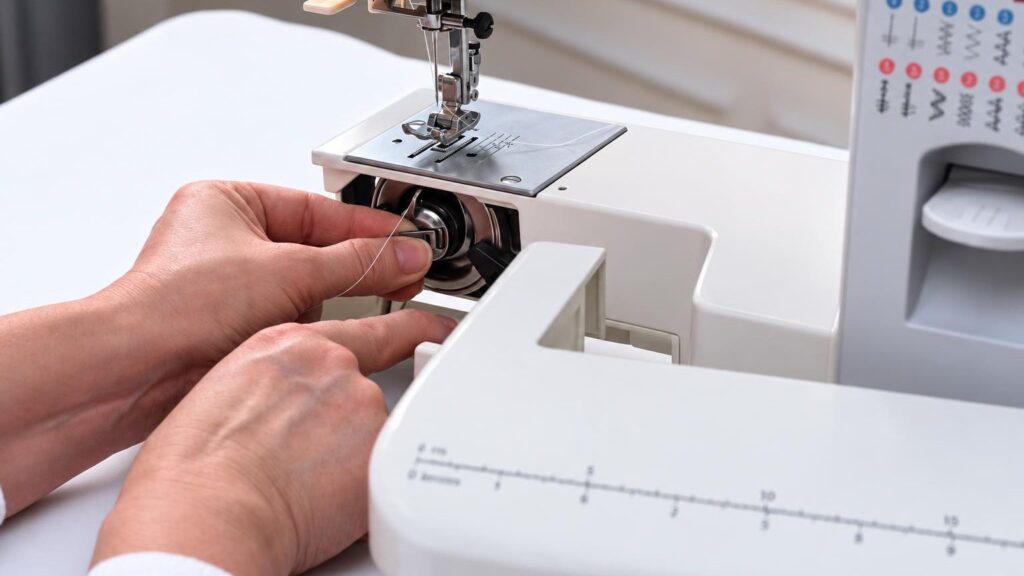
How much does it cost to repair a sewing machine

Initial diagnostics costs 10 €, and the repair price depends on the fault, the model and the parts.

Diagnostics

ServicePriceWarranty
Initial diagnostics10 €–

Repair

ServicePriceWarranty
Sewing machine cleaning, lubrication and adjustmentafter diagnosticsis provided
Overlocker repair and adjustmentafter diagnosticsis provided

Electrics and electronics

ServicePriceWarranty
Repair of pedals, hooks, motors and electronicsafter diagnosticsis provided
We give the repair price after diagnostics and agree on it with you before starting work. A warranty is provided for the work carried out.

Is it worth repairing? Calculate in 10 seconds

Enter the numbers and we will show whether the repair is worthwhile. We give the exact repair price after diagnostics, and we agree on it with you before the repair.

Myths about sewing machine faults

  • Myth. If the machine skips stitches, the fabric is to blame. In fact. More often the needle is at fault: worn, the wrong size or inserted incorrectly. If a new needle does not help, the timing may be out of adjustment.
  • Myth. You should keep turning the thread tension until the seam looks good. In fact. Often the problem is not the tension but incorrectly threaded thread. First re-thread the machine with the presser foot raised.
  • Myth. The more oil, the better. In fact. Too much oil collects dust and hardens. You should oil only the places indicated in the manual and only with special sewing machine oil.
  • Myth. If the machine has sat unused for a long time, nothing in it can be broken. In fact. In a machine that has not been used for a long time, old oil and dust harden, so the mechanism may turn with difficulty or squeak.

When a sewing machine is worth taking to a service center

Some things can be solved with a new needle and re-threading. If that does not help and the machine still skips stitches, the thread keeps breaking, the handwheel turns with difficulty or you hear a rattling noise, then the problem is usually in the mechanism, not in your skill.

Another clear sign is a machine that has sat untouched for a long time. The mass of old oil and dust hardens, and even a healthy mechanism starts to work with difficulty.

  • stitches are skipped even with a new needle
  • the thread keeps breaking despite changing the tension
  • the machine does not respond to the pedal or jams
  • you hear squeaking, rattling or the handwheel turns stiffly

Before bringing it in, change the needle and re-thread the machine – this will make it clearer to the technician whether the problem is really mechanical.

Sewing machine needle and hook close-up

Household machine, overlocker and industrial equipment

Household machines most often need cleaning, lubrication and timing adjustment. For electronic models, we also check the pedal, the motor and the control board.

Overlockers are more sensitive to thread order, knives and loopers, so we adjust them separately. We also service industrial machines, but for a specific model it is better to call and consult us first.

We repair machines from various manufacturers, including Singer, Brother, Janome, Juki, Bernina.

How to maintain your machine to reduce faults

Most problems start with dust and dry moving parts. After each larger project, clean the hook area with a brush, and lubricate only with special sewing machine oil and only in the places indicated in the manual.

Change the needle regularly – a worn needle is one of the most common causes of skipped stitches. Keep the machine covered, in a dry room.

Do not turn the handwheel by force or take the machine apart while it is plugged in – there is mains voltage inside.

Where to bring your sewing machine

We accept sewing machines at all four service points: in Vilnius, Kaunas, Klaipėda and Šiauliai. All service points are open Mon–Fri 9:00–18:00 and closed on weekends. You will find exact addresses and phone numbers on the Contacts page.

If you are not sure whether the repair is worthwhile, call first. And if the price does not suit you, after diagnostics you can simply take the machine back.

What to bring and prepare before going to the service center

  • The sewing machine with its pedal and power cord
  • Remove the threads and take the fabric out from under the presser foot
  • Write down the symptoms: when the fault appears and with which fabric
  • Do not forget additional parts if they are related to the fault (bobbin case, presser foot)
  • Do not take the machine apart yourself – this makes diagnostics more difficult
  • If in doubt, call the nearest service center first

How sewing machine repair works

  1. You bring the machine or call us. You bring the machine to the nearest service center, or first call and describe the symptoms. Bring the pedal and the power cord.
  2. Diagnostics within 1–2 business days. The technician checks the mechanism, the thread path, the pedal, the motor and the electronics. Initial diagnostics costs 10 €.
  3. We agree on the price and timeframe. We tell you what has broken, how much the repair will cost and how long it will take. If the repair is not worthwhile, we tell you so openly.
  4. Repair only with your consent. We start work only after receiving your consent. There are no hidden fees.
  5. You collect it with a warranty. You collect the repaired machine, and a warranty is provided for the work carried out.

Frequently asked questions about sewing machine repair

Why does my sewing machine skip stitches?

The most common causes are a worn or incorrectly inserted needle, the wrong needle size, or a loss of needle and hook timing. First replace the needle; if that does not help, the machine needs adjustment at a service centre.

How much does sewing machine repair cost?

The initial diagnostics cost 10 €. We tell you the repair price after diagnostics; it depends on the fault, the model and the parts. We carry out repairs only with your consent.

How long does the repair take?

The fault is identified within 1–2 business days. We give the repair time after diagnostics, as it depends on the fault and the parts required.

Do you repair overlockers?

Yes, repairing overlockers (serger machines) is one of our services. We adjust the loopers, tensions and the interaction of the knives.

Do I need to book in advance?

You can simply bring the machine to your nearest service point during opening hours Mon–Fri 9:00–18:00. If you would like advice before you come, give us a call.

Do you provide a warranty for the repair?

Yes, a warranty is provided for the work carried out. We will tell you its terms when you collect the machine.

Broken device?

Give us a call – we will tell you what we can do and how long it will take.

Call Find a service point